Modular Home Dealers: Coordinate County Land-Use and State FBB Permits From One Editable Drawing
Build My Site Plan in Minutes → Get a Done-For-You Plan →
Home › Projects › Modular Home Dealers
Two Agencies, One Parcel, Zero Room for a Mismatched Plan
When your dealership sells and sets a modular home—classified in states like Arizona as a Factory-Built Building (FBB)—you aren't just dealing with a local building inspector. You are managing a back-and-forth relay between the county development services department and the state housing agency (such as the Arizona Department of Housing, Office of Manufactured Housing).
Look at how tightly those two agencies interlock on a single modular placement:
- The County issues the land-use or site plan approval first. Neither Yavapai County nor Coconino County lets you skip straight to the state. In Yavapai County, you must provide a copy of the approved, issued county permit to the State as part of your ADOH application. In Coconino County, an approved county site plan is required to continue through the ADOH process.
- The State permits the unit and contract accessories. In Yavapai County, ADOH holds jurisdiction over the installation permit and inspects the unit along with accessory structures included in the sales contract—footings and foundation, mechanical equipment, and awnings—plus gas, water, and sewer/septic yard lines.
- The County comes back in for field verification and close-out. Yavapai County requires proof of the State Permit prior to the county's first inspection and inspects the new or upgraded electric pedestal itself. Coconino County performs the field setback inspection after placement and won't close the county permit until the setter or owner forwards a copy of the completed ADOH Inspection Report and every county division enters final approval.
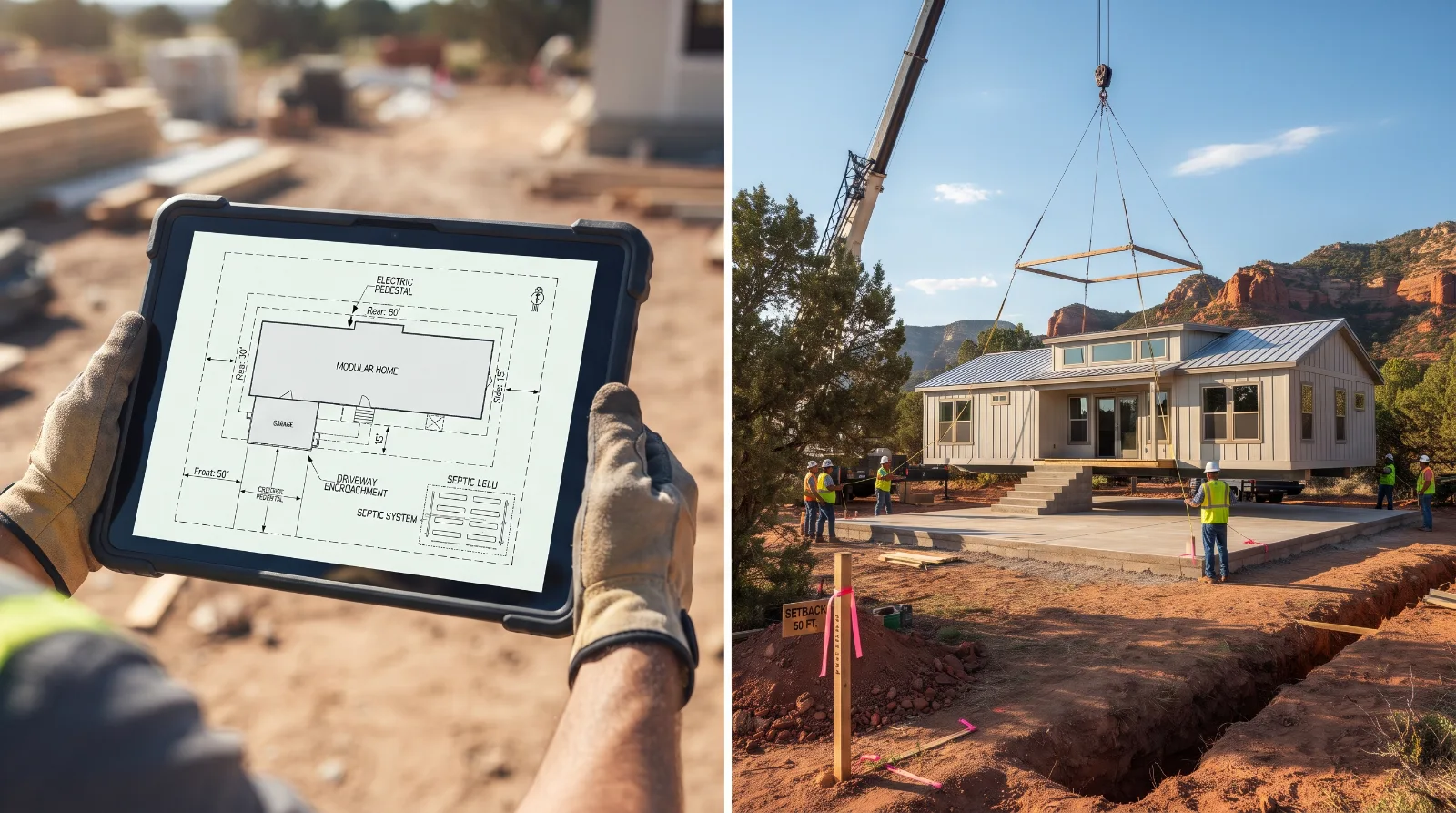
At the center of that relay is your plot plan or site plan. If the drawing is stuck in an outside drafter's backlog—or if a change on the state installation permit triggers a Revised Plot Plan at the county—every step behind it stops.
Who Splits What: County vs. State Jurisdiction on Modular / FBB Jobs
Dealership coordinators waste hours calling the wrong office when a question comes up about utilities, foundations, or setbacks. Here is how the responsibilities divide across three documented Arizona counties:
| Permitting Stage or Item | Yavapai County (Residential & Commercial Modular / FBB) | Coconino County (Unincorporated — Effective Jan 23, 2025) | La Paz County (Placement Permit Rules) |
|---|---|---|---|
| What the County Reviews | Land-use side: Plot Plan to scale (per county instructions) showing all original accessory structures, Floor Plan with all rooms labeled by use, and Completed Septic Permit Form or proof of existing wastewater system. | Only two functions: (1) site plan review for placement, and (2) inspection of zoning setbacks. Portal upload under "Building" → "04. Manufactured and Factory-Built Site Plan Review" requires a scaled site plan, floor plan, and parcel Design Criteria Report. | Placement Permit application (covers Manufactured Homes, RVs, and Containers) with an explicit 10-item Site Plan and proof of approved septic system per Zoning Reg. Section 101.03. |
| What the State (ADOH) Covers | Installation permit and inspection of the unit, including accessory structures in the sales contract (footing/foundation, mechanical equipment, awnings), plus gas, water, and septic/sewer yard lines. | All installation inspections other than the county's zoning setback check. | Installation must be performed by an installer licensed by ADOH (even when the permit is issued to the property owner). |
| Utility & Site Permit Split | Electric pedestal (new or upgraded) must be specified on the application and is inspected by Yavapai County ($150.00 inspection fee, with or without electric). | Approved wastewater system (NOI permit) must be issued prior to issuance of the site plan permit; driveway encroachment permit required for a driveway; conditional permits for floodplain or propane tank. | Separate county building permit required for masonry or wood foundations, porches, awnings, and ramadas; floodplain permit (and possible elevation certificate) required in Special Flood Hazard Areas. |
| When You Need to Revise or Close Out | If the applicant modifies the installation permit with the State, a Revised Plot Plan or additional permit may be required by Yavapai County. | After ADOH inspections finish, the setter or owner must forward the MFH Inspection Report to Coconino County; the county permit cannot close until Planning & Zoning, Engineering, and EQ all enter final approval. | Application is not accepted if the parcel is in active Land Division or Land Combination; unrecorded septic systems must be verified prior to permit issuance. |
Note on Mohave County: If your dealership also delivers into Mohave County, remember that Mohave splits residential plot plans (scaled 8½ × 11" showing steps, landings, and decks at every entrance/exit) from commercial site plans (which must be sealed by an Arizona-licensed engineer or architect on sheets up to 36 × 36").
Five Expensive Surprises Your Dealership Can Prevent at Intake
None of the county documents publish rejection percentages, so we stick strictly to what the checklists themselves flag as deal-stoppers:
1. Submitting the Site Plan Before the Wastewater NOI Is Issued (Coconino)
In unincorporated Coconino County, your upload under "04. Manufactured and Factory-Built Site Plan Review" is routed to Planning & Zoning, Engineering, and Environmental Quality (EQ). The county states plainly that an approved wastewater system (NOI permit) must be issued prior to issuance of the site plan permit. If your buyer hasn't cleared wastewater on an unsewered parcel, your site plan permit cannot issue—which means you cannot advance to ADOH either.
2. Omitting Original Accessory Structures or Room Labels (Yavapai)
In Yavapai County, submitting a plot plan that only shows the modular box will hold up your file if the project includes a carport, awning, shed, or garage. Yavapai requires all original accessory structures shown on the scaled plot plan, plus a companion Floor Plan with all rooms labeled according to use.
3. Assuming Foundations and Porches Ride on the Placement Permit Everywhere
In Yavapai County, footings/foundations and awnings included in the sales contract fall under ADOH's installation permit jurisdiction. Cross into La Paz County, however, and masonry or wood foundations, porches, awnings, and ramadas require a separate building permit from the county. Checking the county rules before you draw the site plan tells your coordinator which permits to apply for on day one.
4. Modifying the State Permit Without Updating the County Plot Plan
Dealers frequently tweak a porch size, awning, or unit position during the ADOH permitting or set phase. In Yavapai County, modifying the state installation permit is a documented trigger that may require a Revised Plot Plan or additional county permit. In Coconino County, the county inspector physically checks the zoning setbacks after placement before the permit can close.
5. Selling Into a Parcel in Mid-Split (La Paz)
Rural buyers often split a 10-acre parcel among family members right before ordering a home. In La Paz County, a placement permit application will not be accepted if the parcel is currently in the Land Division or Land Combination process. Checking the parcel in our tool against county assessor records helps your team spot boundary questions early.
How Dealerships Build and Revise Modular Plot Plans in SitePlans.ai
Instead of outsourcing every site plan to a local drafting shop and waiting in their queue, your permit coordinator or sales manager can build the plan directly in the browser:
- Enter the parcel address and select the lot. In covered counties, the platform automatically loads the parcel boundary with bearings and distances, existing structures, and aerial context—completing roughly 80% of the base drawing immediately.
- Generate zoning setbacks and right-of-way lines. See the exact buildable envelope and check where the driveway meets the road (critical when a Coconino County driveway encroachment permit is needed).
- Place the modular / FBB footprint and all accessory structures. Add the primary home at its exact width and length, then place every attached or detached garage, deck, patio, porch, awning, shed, or fence.
- Map septic, wells, washes, and the electric pedestal. Outline the septic tank, leach trenches, and reserve area; mark domestic wells and desert washes/drainages; and label the new or upgraded electric pedestal location.
- Add full dimension callouts. Dimension all four setback directions from every structure to the property lines, distances between structures, and distances from the septic system to buildings and wells.
- Edit the title sheet and export a scaled PDF. Output a clean, scaled sheet with the north arrow, scale bar, APN, street names, and property address. If a state permit change later triggers a Revised Plot Plan, simply load your saved project, adjust the layout, and export the revised sheet in minutes.
Residential vs. Commercial Modular (FBB) Projects
Many modular dealers supply both single-family homes and commercial factory-built buildings (sales offices, classrooms, medical clinics, workforce housing).
- In Yavapai County, the published submittal criteria apply to all residential and commercial manufactured/modular/factory-built buildings.
- In Mohave County, residential projects use the 8½ × 11" Plot Plan, whereas commercial projects require a formal Site Plan sealed by a licensed Arizona professional engineer or architect (up to 36 × 36").
- Across all counties, none of the reviewed residential submittal checklists for Yavapai, Coconino, or La Paz state a surveyor or engineer seal requirement for a residential plot/site plan itself—but commercial FBB projects, floodplain parcels, or local grading triggers frequently require sealed engineering. Always confirm directly with the county before submitting.
Working on commercial modular sites? See our dedicated guide for commercial real estate site plans, or use our home builder plans and contractor plans for multi-lot residential operations.
Where Automatic Parcel Data Is Live
In covered counties, entering an address pulls parcel lines, bearings, distances, and existing building footprints automatically:
| State | Confirmed Covered Counties |
|---|---|
| Arizona | Mohave County |
| Texas | Montgomery, Travis, Denton, Fort Bend, Dallas |
| Florida | Miami-Dade, Broward, Pinellas, Pasco, Lee, Manatee, Palm Beach |
| North Carolina | Wake, Durham, Guilford, Buncombe, Forsyth |
| Georgia | Fulton, DeKalb, Gwinnett, Cobb, Henry, Paulding, Douglas |
| South Carolina | Charleston |
| Tennessee | Davidson County, Hamilton |
Setting modular homes in Yavapai, Coconino, or La Paz County?
Automated parcel pull in Arizona is currently confirmed for Mohave County, with additional Arizona counties on the expansion roadmap. When you have a placement in Yavapai County, Coconino County, La Paz County, or any county outside current automated GIS coverage—or when your permitting desk wants a human team to draw a complex site—you can order a human-reviewed, non-certified plot plan through SitePlans.us.
Pricing for Modular Dealerships
Your first plan is free — no card required. Try it on a real lot and evaluate the exported PDF with your permitting coordinator.
| Plan | Price | Best For | What You Get |
|---|---|---|---|
| Free / Basic | $0 | Single lot test or one-off placement | One project, 5 PDF exports, letter landscape title sheet, editable title block, property lines |
| Contractor Pro | $69/mo | Turnkey modular dealers & set contractors | Repeat monthly projects, branded title blocks, layer management |
| Builder Plan | $299/mo | Multi-branch dealerships & FBB developers | High-volume projects, multiple sheet sizes, company branding, advanced layers |
| Done-For-You | From SitePlans.us | Unmapped counties, complex sites, or backlog | Human-reviewed, non-certified permit-style site plan |
For Enterprise deals contact sales@siteplans.ai
What This Doesn't Replace
SitePlans.ai produces preliminary, conceptual, permit-style site plans and plot plans for projects where local rules allow dealer-, homeowner-, or contractor-prepared drawings. It does not replace:
- A licensed land boundary survey
- A sealed commercial site plan or PE/PLS/architect stamp
- Engineered foundation, stem-wall, or tie-down plans
- Room-labeled architectural floor plans or factory FBB blueprints
- A parcel Design Criteria Report, wastewater NOI permit, or septic engineering
- A FEMA Floodplain Permit or Elevation Certificate
- Your state ADOH installation permit or a guarantee of permit approval
Where a county or state agency requires a licensed surveyor, an engineered foundation plan, or a sealed professional drawing, that requirement must still be followed.
Frequently Asked Questions
1. Why are modular homes permitted through both the county and the state in Arizona?
Because Arizona splits jurisdiction on Factory-Built Buildings (FBB). As documented in Yavapai County's submittal criteria, the county permits the land-use side (zoning, setbacks, and site layout), while the Arizona Department of Housing (ADOH), Office of Manufactured Housing, has jurisdiction over the installation permit and inspection of the unit, including accessory structures in the sales contract (footing/foundation, mechanical equipment, awnings).
2. Which permit has to be issued first—the county permit or the ADOH state permit?
In both Yavapai County and Coconino County, the county approval comes first. Yavapai County requires the applicant to provide a copy of the approved, issued Yavapai County permit to the State as part of the State application. Coconino County requires an approved county site plan before continuing through the ADOH process.
3. When does Yavapai County require proof of the State Permit?
Proof of the State Permit must be submitted to Yavapai County prior to the county's first inspection.
4. What triggers a Revised Plot Plan in Yavapai County?
If the applicant modifies the installation permit with the State (for example, changing the footprint, orientation, or contract accessory structures), a Revised Plot Plan or additional permit may be required by Yavapai County. Keeping your project saved in SitePlans.ai lets your coordinator generate that revised drawing in minutes.
5. How does Coconino County's January 23, 2025 process change affect modular / FBB dealers?
Since January 23, 2025, Coconino County Community Development only performs (1) site plan review for placement and (2) inspection of zoning setbacks for manufactured homes and factory-built buildings in the unincorporated county. ADOH completes all other inspections. To close the county permit after placement, the setter or owner must forward a copy of the completed ADOH Inspection Report to Coconino County so all divisions can enter final approval.
6. What documents must be uploaded to Coconino County's portal for an FBB site plan review?
Under portal category "Building" and option "04. Manufactured and Factory-Built Site Plan Review," the applicant uploads three items: a scaled site plan, a floor plan, and a copy of the parcel's Design Criteria Report. In addition, an approved wastewater system (NOI permit) must be issued prior to issuance of the site plan permit.
7. Does Yavapai County charge an electric inspection fee even if no new electric pedestal is installed?
Yes. Yavapai County's submittal criteria state that the application must specify whether a new or upgraded electric pedestal is needed, the electric pedestal is inspected by Yavapai County, and the inspection fee is $150.00, with or without electric. Gas, water, and septic/sewer yard lines are inspected by the State as part of the installation permit.
8. Does a modular plot plan require a surveyor or engineer seal?
None of the published residential submittal criteria reviewed for Yavapai, Coconino, or La Paz counties state a seal requirement for the plot/site plan itself. However, commercial site plans (such as in Mohave County) and special site overlays often require an Arizona PE or architect seal. Always confirm seal requirements directly with the local county permitting office.
9. Do we need a separate permit for a driveway on an unincorporated Coconino County lot?
Yes. Coconino County notes that an encroachment permit is required for a driveway, and other conditional permits may apply depending on site conditions (such as floodplain or propane tank permits).
10. What if our dealership also places Park Models?
Check local age rules carefully: under Section 565 of the Yavapai County Planning and Zoning Ordinance, Park Models are allowed as dwelling units but must not be more than five years old at the time of installation. In La Paz County, newly placed manufactured homes or Park Models must be manufactured on 06/15/1976 or newer.
11. Can multiple coordinators in our dealership share and edit the same plot plan file?
Yes. Using save and load project and complete walkthrough, your sales desk can create the initial feasibility layout and your permit coordinator can open the same project to add dimensions and export the final PDF.
12. Does SitePlans.ai guarantee our county site plan or FBB permit will pass review?
No. Every county reviews submittals against its own zoning, engineering, and environmental rules and may require revisions. SitePlans.ai gives your dealership a fast, repeatable tool to draw and update scaled preliminary plans in-house.
Keep Your Next Modular Set on Schedule
Stop letting a two-agency paper trail or an outside drafter's calendar push back your crane and set crew. Open a live customer parcel right now, lay out the modular footprint and accessory structures, and see how fast your dealership can produce the plot plan in-house.
Need a human drafting team to handle an unmapped county or a complex commercial lot?