The Short Answer
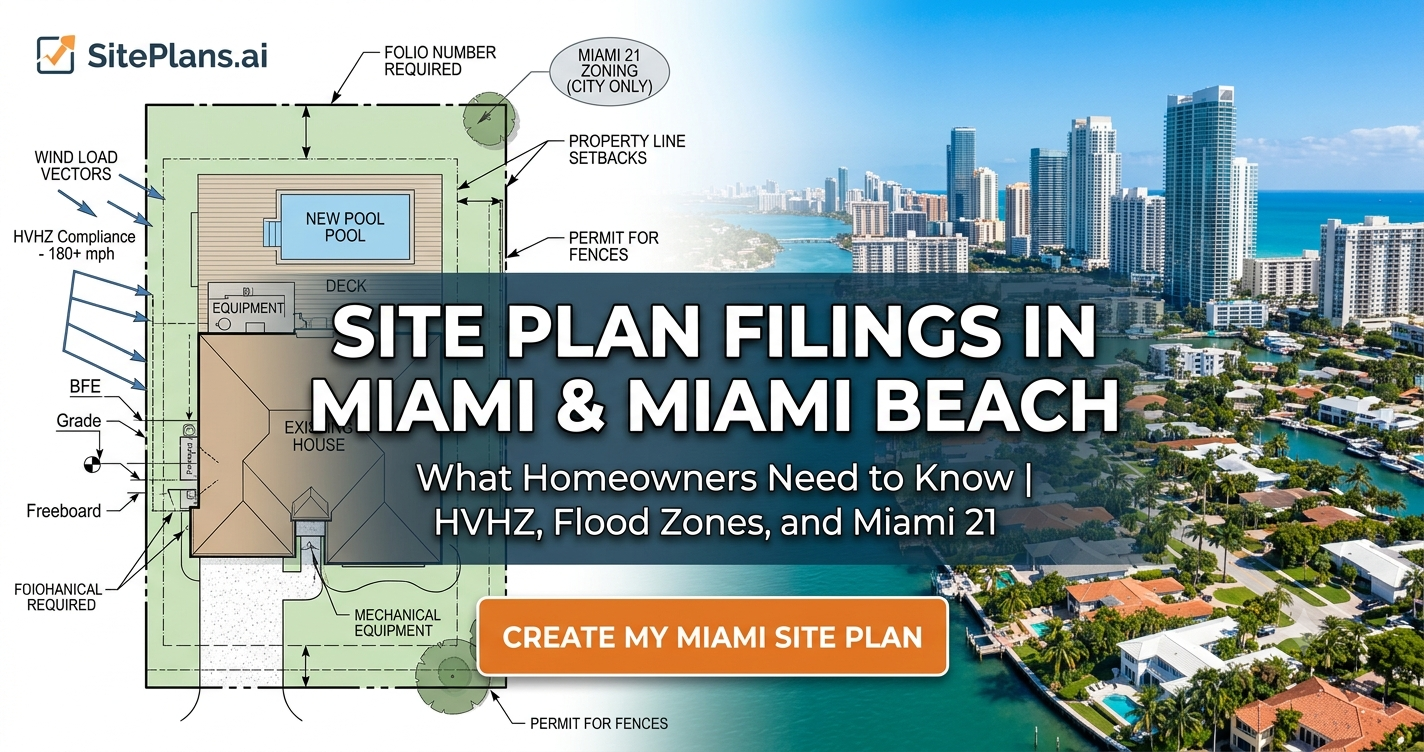
Miami and Miami Beach require site plans that show property lines, setbacks, existing and proposed structures, flood zone information, and HVHZ compliance. Unlike many cities, Miami-Dade County requires permits for all fences — no minimum size exemption exists. And Miami Beach requires sealed architectural plans for most projects.
Miami-Dade County: The Big Picture
Miami-Dade County issued more than 34,000 building permits in 2024. Not one moved forward without a site plan. The county is divided into 34 incorporated municipalities, each with its own building department.
Key facts about Miami-Dade permits:
- All fences require a permit — no minimum size exemption
- All structures must meet HVHZ standards — 185 mph wind load
- Flood zone information is required on every site plan
- A 13-digit folio number is required on all applications
Miami Beach: Even Stricter
Miami Beach has additional layers of review on top of Miami-Dade County requirements.
Miami Beach site plan requirements include:
- Setbacks from property lines
- Existing and proposed structures
- Property lines with dimensions
- Lot dimensions
- Grade elevation as per survey
- All proposed structures — fences/walls, accessory buildings, pools, decks, walkways, mechanical equipment
- BFE, Grade, Adjusted Grade, Freeboard in NGVD values
Miami Beach also requires:
- Signed and sealed architectural plans
- Digital or electronic signatures and seals on drawings
HVHZ: The Miami-Dade Difference
and Broward are the only two counties in the U.S. designated as High-Velocity Hurricane Zones (HVHZ). This means:
- Design wind speed: 170-180+ mph
- Impact-resistant glazing required on all exterior openings
- NOA product approvals required for all building components
- HVHZ notation required on site plans
Flood Zone Requirements
Miami and Miami Beach properties are often in flood zones. Your site plan must show:
- BFE (Base Flood Elevation)
- Grade elevation
- Adjusted Grade (if applicable)
- Freeboard (if applicable)
Miami 21 Zoning (City of Miami Only)
The City of Miami uses Miami 21 — a form-based zoning code that regulates building shape and placement, not just use. Setbacks vary by transect zone:
| Zone | Front Setback | Side Setback | Rear Setback |
|---|---|---|---|
| T3 (Sub-Urban) | 20 ft | 10 ft | 20 ft |
| T4 (General Urban) | 10 ft | 5 ft | 20 ft |
| T5 (Urban Center) | 0-10 ft | 0 ft | 10 ft |
| T6 (Urban Core) | 0 ft | 0 ft | 10 ft |
What Your Miami/Miami Beach Site Plan Must Include
Based on official checklists, your site plan must show:
- Property lines with dimensions
- Existing structures
- Proposed structures (clearly distinguished)
- Setbacks from property lines
- Lot dimensions
- Grade elevation as per survey
- Fences/walls (if applicable)
- Accessory buildings (if applicable)
- Pools (if applicable)
- Decks and walkways (if applicable)
- Mechanical equipment (if applicable)
- BFE, Grade, Adjusted Grade, Freeboard (if applicable)
Common Mistakes That Delay Miami Permits
| Mistake | What to Do Instead |
|---|---|
| No HVHZ notation | All site plans must include wind speed compliance notation |
| No flood zone information | BFE and FFE must be shown on every plan |
| Missing folio number | The 13-digit Miami-Dade folio number is required |
| No professional seal | Miami Beach requires sealed plans for most projects |
| Assuming fences don't need permits | Miami-Dade requires permits for all fences |
| Wrong Miami 21 setbacks | Check your transect zone on the Miami 21 Zoning Atlas |
How to Get a Miami Site Plan
Option 1: DIY with Our Site Plan Creator (Free untill 2027)
Enter your Miami address, see your property lines, add your proposed project, and export a PDF. Free for your first plan.
Option 2: Done-for-You
If your project is complex, has been rejected, or requires a human-reviewed plan, order a non-certified, permit-ready plan from SitePlans.us.
Option 3: Licensed Professional
If your project requires a sealed survey or stamped plans, hire a licensed Florida surveyor, engineer, or architect.
Create My Miami Site Plan Now from address under 10 minutes
FAQ
Q: Do I need a site plan for a fence permit in Miami-Dade?
A: Yes. Miami-Dade County requires permits for all fences — no minimum size exemption exists.
Q: What is HVHZ and why does it matter?
A: HVHZ (High-Velocity Hurricane Zone) is a designation unique to Miami-Dade and Broward counties with the nation's strictest wind resistance standards (170-180+ mph).
Q: Do I need a sealed plan for a Miami Beach permit?
A: Yes. Miami Beach requires signed and sealed architectural plans for most projects.
Q: What is Miami 21?
A: Miami 21 is the City of Miami's form-based zoning code that regulates building shape and placement. Setbacks vary by transect zone (T3, T4, T5, T6).
Q: Can I use SitePlans.ai for a Miami permit?
A: Yes, for early planning and visualization. Miami typically requires sealed plans for final submission. Always verify with your local building department.
Q: What if my Miami site plan gets rejected?
A: You can revise it yourself using our site plan creator, or order a done-for-you plan from SitePlans.us (non-certified, permit-ready only).